Flow Fit - Word Puzzle
Big Duck Games LLCWord
4.5900.00 Reviews
- Version
- 1.2.3
- Installs
- 100.00K
- Age Rating
- Everyone
Screenshots
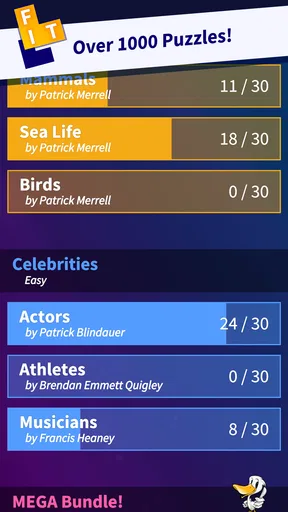
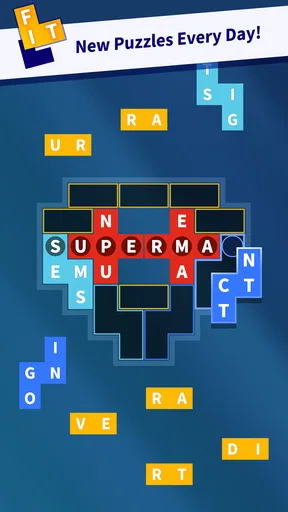
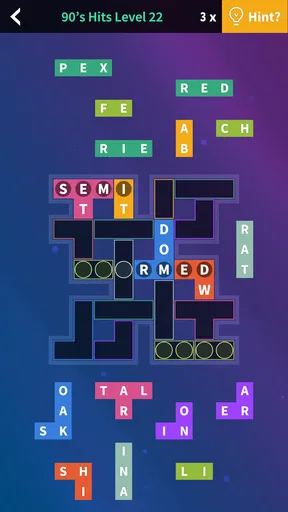
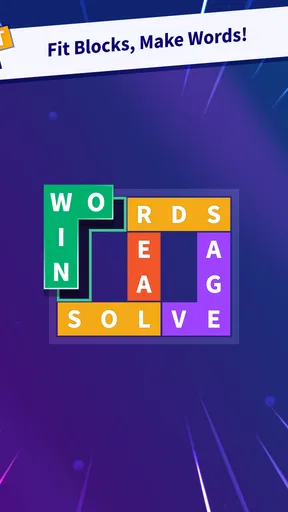
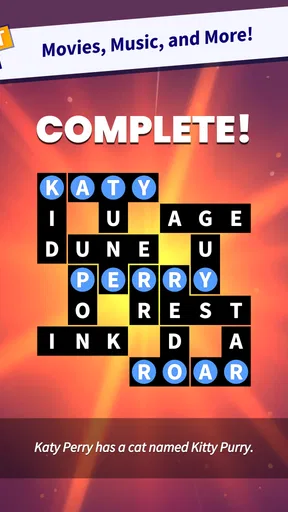
Our Review of Flow Fit - Word Puzzle
 Analysis by Appyee
I found Flow Fit most interesting when I stopped treating it like a normal word game. It is not simply about spotting vocabulary, and it is not quite a traditional block puzzle either. Each round asks me to fit pieces into a board while building words, so the appeal comes from handling two kinds of decisions at once: where a shape belongs and which letters can work together. That combination gives it a more thoughtful rhythm than a quick anagram game, without becoming as demanding as a full crossword.
My overall view is positive, with one important qualification: this is best for players who enjoy experimenting and making small adjustments rather than chasing a rapid score or a large collection of game modes. The free entry point makes it easy to try, and the Everyone rating makes it suitable for a broad audience. Still, the hybrid design will not satisfy people who want a pure vocabulary challenge or a highly competitive puzzle experience.
How the word-and-block design feels in practice
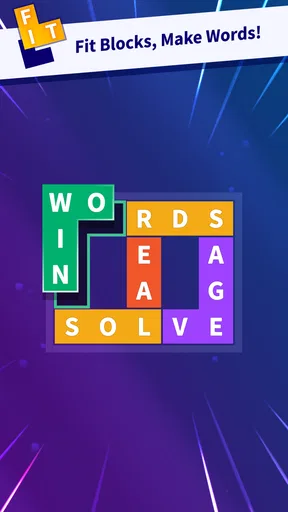
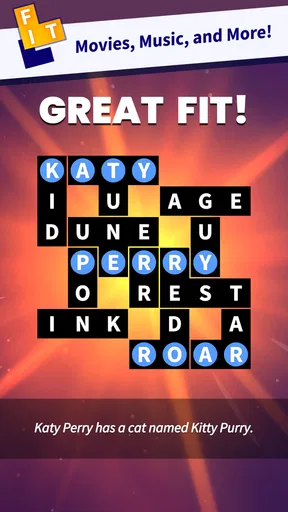
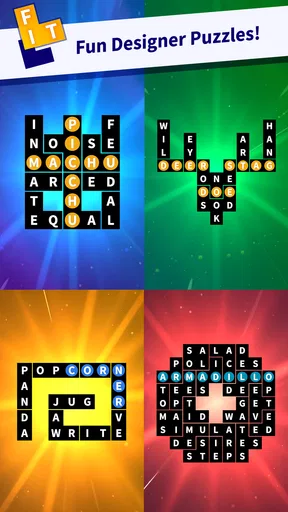
The central idea is easy to understand. Letters are arranged in block-like pieces, and I place those pieces so that completed lines or spaces form words. The result feels halfway between a crossword and a jigsaw puzzle, but the important difference is that the board changes the way I think about language. I am not only asking, “What word can I make?” I am also asking, “Can I make it fit without ruining the next move?”
That second question is where the game earns its identity. In an ordinary word search, recognizing a word is usually the main achievement. Here, recognition is only one part of the solution. A promising letter group may be useless if its shape blocks the remaining spaces. Conversely, an awkward-looking piece can become valuable when it completes a word and opens room for a better arrangement.
I like that the basic rules can be understood almost immediately. There is no need to memorize a complicated scoring system before playing. The board communicates the problem visually, while the letters provide the mental challenge. This makes it approachable for someone who normally plays casual mobile puzzles but still gives experienced word-game players a reason to look for more efficient arrangements.
The strongest evidence of the design working is the way a small mistake can change the whole round. Placing a piece too early may leave an uncomfortable gap or force a weaker word later. That creates a gentle form of planning without making every move feel irreversible or intimidating. I often found myself taking a second look at the available pieces before committing, which is a good sign for a puzzle that wants attention rather than automatic tapping.
It also works well in short sessions. I can play while waiting for an appointment or during a quiet break without needing to remember a complicated story or manage a long-term character system. The game’s structure supports a “one more puzzle” habit, but the decisions are substantial enough that a round does not feel like a completely empty time filler.
Why the hybrid format is more than a cosmetic twist
Many mobile word games add a visual theme to familiar anagrams, but this one makes the physical arrangement part of the challenge. That matters because it changes the value of common letters. A letter is not useful only because it appears in many words; it is useful when its block can occupy the right space at the right moment. I learned to judge a piece by both its spelling potential and its geometry.
That creates a practical strategy that is easy to miss at first: I try not to spend the most flexible pieces immediately. A block that can participate in several possible words may be more valuable later than a piece that forms an obvious short word now. This is not a formal advanced mode, just a way of reading the board more carefully, but it makes the puzzles feel deeper than the store summary suggests.
Another useful habit is to scan the empty spaces before scanning the letters. If I start by hunting for words, I can become attached to an attractive combination that does not fit cleanly. Looking at the board first helps me identify which shapes are urgent and which areas should remain open. That small change in workflow reduces wasted moves and makes the game feel less random.
I also found that unfinished words can be useful as temporary anchors. I do not always need to solve an entire word in one thought. Sometimes placing a likely letter group reveals whether the remaining space supports a sensible completion. This makes the game approachable for players who are better at visual puzzles than vocabulary tests, because the board can help guide the language rather than demanding that every answer be known immediately.
Where it fits among familiar word games
Compared with a crossword, Flow Fit feels less dependent on clues and general knowledge. A crossword usually asks me to retrieve a specific answer from a definition or theme. Here, the available pieces and the board layout do more of the prompting. That makes it a better choice when I want wordplay without the pressure of obscure trivia or carefully written clues.
Compared with an anagram game, it is less purely linguistic. I cannot always solve a round by quickly rearranging letters in my head because the physical arrangement matters. Players who enjoy finding words at high speed may find the block-placement element slows them down, but I see that as the point rather than a flaw.
Compared with a falling-block puzzle, it is more deliberate. The focus is not simply on reacting before pieces reach the bottom. I have more room to inspect possibilities and consider how one placement affects the next. That makes it a better fit for relaxed concentration, although people seeking fast reflexes and escalating action should probably choose a different type of puzzle.
This positioning is the game’s clearest strength. It gives casual players a familiar entry point while offering enough planning to avoid feeling like a basic word scramble. The experience is especially appealing if you enjoy both arranging shapes and noticing spelling patterns, but neither interest needs to be highly advanced to get started.
The everyday situations where it works best
I would recommend it for a short commute, a waiting room, or a quiet evening when I want something more engaging than scrolling but less demanding than a long strategy game. Because the core activity is self-contained, I do not need to prepare mentally for a large session. I can finish a small stretch of play and put the phone away without losing the thread of a story or leaving a team dependent on me.
It can also suit families with different gaming tastes. A younger player may focus on fitting pieces, while an older player may pay more attention to word possibilities and future space. The Everyone content rating supports that broad accessibility, though individual reading ability will naturally affect how comfortable someone feels with the word challenges.
For language learners, I see a limited but genuine benefit. The game can encourage attention to spelling patterns and short word construction, especially when the board makes a possible combination visible. I would not treat it as a language course, because the experience is designed around solving puzzles rather than explaining vocabulary, but it can be a pleasant supplement for someone who already enjoys learning through play.
It is less suitable for a group gathering unless everyone is happy to take turns looking at one device. This is primarily a personal puzzle experience, not a social party game. Likewise, anyone who needs accessibility options tailored to a particular visual or motor requirement should check the current device experience before committing to extended sessions; the core appeal depends heavily on reading letters and manipulating shapes on a compact screen.
The main weakness: the hybrid can feel restrictive
The same feature that makes Flow Fit distinctive can also create friction. When I see a word I want to build but cannot place it comfortably, the limitation can feel less like a clever puzzle and more like the board is getting in the way. Players who prefer the freedom of forming any valid word may find the spatial rules unnecessarily constraining.
There is also a learning curve in understanding what to prioritize. The rules are simple, but good decisions are not always obvious. Early rounds can feel slightly awkward while I learn to balance immediate word completion against preserving useful space. That is a meaningful trade-off: the game rewards patience, but it may not deliver instant satisfaction to someone expecting every available letter combination to produce a clear move.
The format can become repetitive if I want constant novelty from different puzzle systems. Its appeal comes from refining the same core loop—fit pieces, recognize words, protect the board—not from switching between radically different activities. I consider that focused design a strength for regular short play, but a weakness for players who quickly tire of repetition.
The free price lowers the risk of trying it, while optional in-app purchases range from $0.99 to $2.99 per item. I would begin without spending anything and see whether the basic loop holds my attention. The presence of purchases is worth remembering if I am choosing a game for a child, not because the amount is unusually high, but because any optional spending deserves supervision on a shared device.
The current version is 1.2.3, and the game requires Android 6.0 or later. That makes device compatibility a practical check before installation, particularly on an older phone or tablet. The developer, Big Duck Games LLC, presents this as a compact word-puzzle experience rather than a large content-heavy game, so I would judge it by the quality of its central loop instead of expecting the breadth of a major puzzle collection.
Who should download it, and who should skip it
I think it is a strong match for someone who likes word games but wants a visual layer to make each answer feel earned. It is also a good choice for players who enjoy arranging objects, planning several moves ahead, and solving problems at a calm pace. If you like the satisfaction of finding a neat fit rather than merely typing a correct answer, this is where the game is most convincing.
It should appeal to casual players who want a free game that can be sampled without a large commitment. The audience is already substantial, with over one hundred thousand installs, and its average rating is 4.5 from around three and a half thousand ratings. I read that as encouraging evidence that the concept connects with many players, while still leaving room for the personal preference issues that come with any focused puzzle format.
I would skip it if my priority were competitive leaderboards, fast reactions, elaborate progression, or a constant stream of different modes. I would also choose a conventional crossword if I specifically wanted clues, themes, and general-knowledge solving. An anagram game would be better for pure vocabulary speed, while a traditional block puzzle would be preferable if I wanted to think only about spatial efficiency.
One practical recommendation is to play the first sessions slowly instead of tapping the first acceptable word. The game becomes more rewarding when I treat each piece as a resource. I look for the tightest spaces, keep flexible blocks available, and use partial arrangements to test possibilities. That approach exposes the strategic side of the design and helps separate a genuinely useful move from a merely available one.
I would also avoid judging it after only a few rushed rounds. Its pleasure is cumulative: once I understand how the word goal and the board layout influence each other, the decisions become clearer. On the other hand, if that relationship still feels restrictive after a fair trial, more time is unlikely to transform it into a different kind of game. Its identity is firmly built around the tension between language and shape.
My final recommendation
Flow Fit succeeds because its two puzzle traditions genuinely affect each other. The words are not decoration on top of block placement, and the blocks are not merely a visual wrapper for an anagram. I have to think about spelling, space, timing, and future options together, which gives the simple premise a satisfying amount of depth.
Its limitations are clear as well. The focused loop may feel repetitive, the spatial restrictions can frustrate players who want freer word creation, and it does not replace a crossword, an anagram challenge, or a fast block game for people seeking those specific experiences. Optional purchases also mean I would keep an eye on spending when the game is used by younger players.
For me, the final verdict is that this is a worthwhile free download for relaxed puzzle fans, especially anyone curious about a word game with a physical, jigsaw-like element. I would recommend trying it during short breaks and approaching the board as a planning problem rather than a race. If that blend clicks, the game offers a distinctive and pleasantly thoughtful way to play with words.
Verdict
Strengths of Flow Fit - Word Puzzle
- Simple rules make it easy to start playing immediately.
- Short levels are convenient for quick breaks or casual sessions.
- Clean visuals keep the puzzle board easy to read.
- Gradual challenges help improve pattern-recognition skills.
- Offline play makes it useful when internet access is limited.
Limitations of Flow Fit - Word Puzzle
- Later puzzles can feel repetitive if you play for long sessions.
- Some solutions may require trial and error rather than clear deduction.
- Small screens can make certain pieces harder to manipulate accurately.
- The difficulty curve may feel uneven between individual levels.
- Hints or extra features may be limited without optional purchases.
Similar Picks in This Category
View All
Word Search - Word Puzzle Game
Bluetile4.8

Word Search Quest - Puzzles
Blackout Lab4.8

CodyCross: Crossword Puzzles
Fanatee, Inc.4.7

Words of Wonders: Crossword
Fugo Games4.9

Wordscapes: Word puzzle game
PeopleFun4.7

Word Search Explorer
PlaySimple Games4.9
Frequently Asked Questions
What is Flow Fit - Word Puzzle?
Flow Fit - Word Puzzle is a relaxing word game that combines vocabulary challenges with a fitting-style puzzle board. Instead of simply finding words in a list, you arrange letter pieces or word fragments into the correct spaces to complete the puzzle. The game is designed for short sessions, gradually increasing difficulty, and a calm experience suitable for players who enjoy both word games and logic puzzles.
How do you play Flow Fit - Word Puzzle?
Gameplay generally involves examining the available letters, words, or shaped pieces and placing them into matching positions on the board. You need to use context, spelling, and spatial awareness to determine the correct arrangement. Some levels can be solved quickly, while others require testing different combinations. The interface is easy to understand, although later puzzles may demand patience and careful planning rather than fast reactions.
Is Flow Fit - Word Puzzle free to download and play?
Flow Fit - Word Puzzle can typically be downloaded for free, allowing players to access the main puzzle experience without an initial purchase. However, free mobile games may include advertising, optional in-app purchases, or both. These extras can sometimes provide hints, remove ads, or offer additional benefits. Before downloading, check the current Google Play or App Store listing for accurate pricing and purchase details.
Does Flow Fit - Word Puzzle work offline?
Many puzzle levels may be playable without a continuous internet connection, which makes Flow Fit - Word Puzzle convenient for travel, commuting, or areas with unreliable service. Nevertheless, an internet connection may still be required for advertisements, cloud synchronization, account features, updates, or in-app purchases. Offline availability can also vary between versions, so it is worth testing the game after installation with Wi-Fi and mobile data disabled.
Is Flow Fit - Word Puzzle suitable for all ages?
Flow Fit - Word Puzzle is generally appropriate for players who enjoy word-based challenges and simple logic gameplay, including older children, teenagers, and adults. The main considerations are vocabulary level, reading ability, and the presence of advertisements or optional purchases. Younger players may need supervision when using a shared device. Parents should review the store’s age rating, privacy information, and purchase settings before allowing children to play.
Play our best games!


